Koos van der Lende
The Koos van der Lende Archive

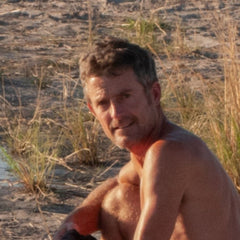
Koos van der Lende

Koos van der Lende photographs on a 6 × 17 cm panoramic camera, entirely by hand, and nothing is altered afterwards. For eighteen years he worked alone in the wild places of Southern Africa, eight to ten weeks at a time, carrying three hundred rolls of film that hold four pictures each.

Read more

How a picture is made

He does not make many pictures of one place, he makes one. He walks the land with three small viewers matching his three lenses, marks a spot, walks away, then comes back hours later without looking, to see whether he arrives at the same place. A compass tells him where the sun will rise. Often the camera is set the evening before, wrapped in plastic for the night, and he sleeps beside it. When the light comes he works fast, carrying up to twelve reflector boards to throw the low sun into a tree, running from board to board as the angle changes. After sunset he paints trunks and rocks with a hand lamp through exposures of many minutes, walking into the frame dressed in black, invisible to the film. He leaves no fire and no footprints. Two pictures on a lucky day, and sometimes twelve days for one.

“I don’t want a record of a landscape. It has to be art. The slide, the transparency, is my canvas.” — Koos van der Lende

The collections

Baobab, Classic, Sacred Forests, Solitary Survivor, Evidence of Mankind, Water Pear Tree, and the Latest Release, eight panoramas from the archive offered for the first time, half of them from two months alone in the Niassa in northern Mozambique. His book, Moments of Grace, gathers the work in print.

Recognition

His close study of a welwitschia in the Namib Naukluft was commended at the BBC Wildlife awards in London, where a judge said she had never seen the plant so well photographed. He was commissioned to photograph every national park in South Africa in panoramic format for a series of postage stamps, and he worked for years alongside the Peace Parks Foundation, photographing the transfrontier parks, which gave him access to country few people are allowed to enter.

The prints, and the originals

Each work is an archival pigment print from the original slide, signed and numbered, with a certificate of authenticity, in editions of twenty five across all sizes together. Nothing is altered, so the print carries what the film carried. The original transparencies, one of one, are offered privately to collectors through the gallery. His own site, delende.com, carries the full story, the films and his field notes.

  • 6 × 17 cm panoramic film
  • 18 years alone in the field
  • 4 pictures to a roll
  • 93 works in the shop
Dead Vlei
Dead Vlei
The story

Eighteen years alone, for the best he could make.

Koos was born in Pretoria in 1955, trained at the School of Photography in The Hague, and came back to South Africa for good in 1983. For twenty years he worked as a commercial photographer, and every holiday went to the Kalahari and Namibia. Then he flew to New York and bought a Fuji 6 × 17 cm panoramic camera, entirely manual, the picture appearing upside down on the ground glass under a black cloth, as it has for a hundred years.

In 2002 he stopped working for money. He gave the panoramic work to God and set out to make the very best he could, however long it took. For the next eighteen years he travelled alone through Namibia, Botswana, Zimbabwe, Zambia, Malawi, Angola, Mozambique and South Africa, eight to ten weeks at a time, with food for two months, water for three or four weeks, three hundred rolls of film and no telephone. If he was not back after eleven weeks, they were to come and look for him.

Read more

How a picture is made

He does not make many pictures of one place, he makes one. He walks the land with three small viewers matching his three lenses, marks a spot, walks away, then comes back hours later without looking, to see whether he arrives at the same place. A compass tells him where the sun will rise. Often the camera is set the evening before, wrapped in plastic for the night, and he sleeps beside it. When the light comes he works fast, carrying up to twelve reflector boards to throw the low sun into a tree, running from board to board as the angle changes. After sunset he paints trunks and rocks with a hand lamp through exposures of many minutes, walking into the frame dressed in black, invisible to the film. He leaves no fire and no footprints. Two pictures on a lucky day, and sometimes twelve days for one.

“I don’t want a record of a landscape. It has to be art. The slide, the transparency, is my canvas.” — Koos van der Lende

The collections

Baobab, Classic, Sacred Forests, Solitary Survivor, Evidence of Mankind, Water Pear Tree, and the Latest Release, eight panoramas from the archive offered for the first time, half of them from two months alone in the Niassa in northern Mozambique. His book, Moments of Grace, gathers the work in print.

Recognition

His close study of a welwitschia in the Namib Naukluft was commended at the BBC Wildlife awards in London, where a judge said she had never seen the plant so well photographed. He was commissioned to photograph every national park in South Africa in panoramic format for a series of postage stamps, and he worked for years alongside the Peace Parks Foundation, photographing the transfrontier parks, which gave him access to country few people are allowed to enter.

The prints, and the originals

Each work is an archival pigment print from the original slide, signed and numbered, with a certificate of authenticity, in editions of twenty five across all sizes together. Nothing is altered, so the print carries what the film carried. The original transparencies, one of one, are offered privately to collectors through the gallery. His own site, delende.com, carries the full story, the films and his field notes.

The book, Moments of Grace
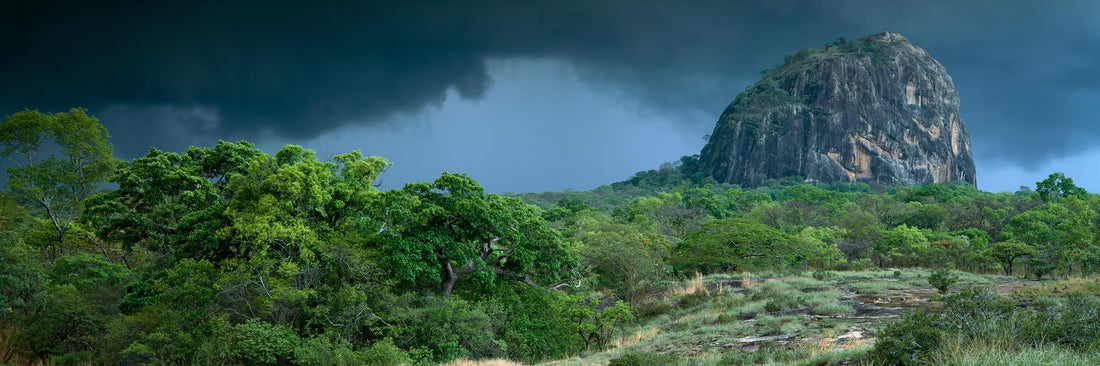
Coming Storm by Koos van der Lende, a dark storm sky over a granite inselberg and green bush
The collections

Seven bodies of work.

Every panorama is printed from the original slide, signed and numbered in an edition of 25 across all sizes together.

The craft

Law, and grace.

Koos speaks of composition the way he speaks of faith. There are laws, the rules every photographer learns and must respect. But a panoramic frame is only six centimetres high, and some of those rules no longer fit. Knowing when to keep them and when to set them aside, he calls grace.

Under the black cloth the picture is small and upside down. He cannot see the detail, only the balance of the whole, and that is when he knows.

Read more

He does not make many pictures of one place, he makes one. He walks the land with three small viewers matching his three lenses, marks a spot, walks away, then returns hours later without looking, to see whether he arrives at the same place. A compass tells him where the sun will rise. Often the camera is set the evening before, wrapped in plastic for the night, and he sleeps beside it.

When the light comes he works fast, carrying up to twelve reflector boards to throw the low sun into a tree, running from board to board as the angle changes. After sunset he paints trunks and rocks with a hand lamp through exposures of many minutes, walking into the frame dressed in black, invisible to the film. He leaves no fire and no footprints. Two pictures on a lucky day, and sometimes twelve days for one.
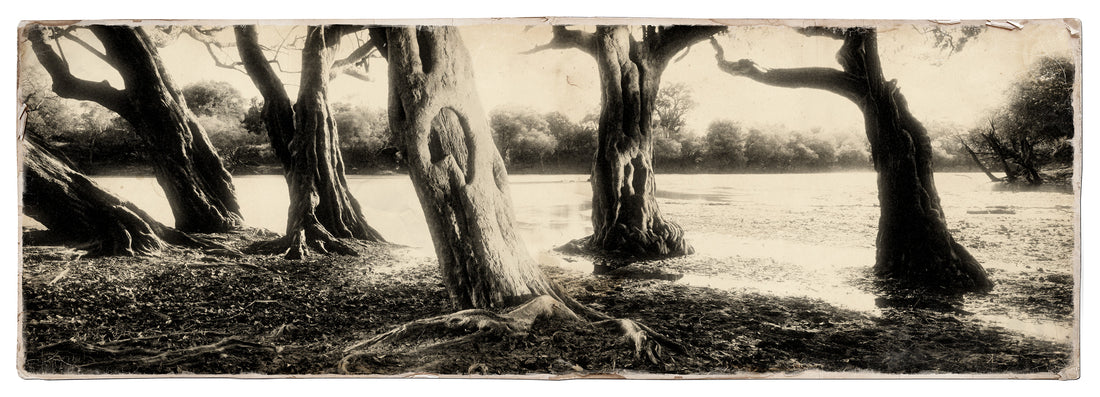
Water Pear Tree No.3 by Koos van der Lende, old trunks standing in a river, backlit
For collectors

The original transparencies.

Every print comes from a single original slide, one 6 × 17 cm transparency, exposed in the field and never altered. There is no second original, and there never will be. Selected originals are offered to collectors, negotiated privately through the gallery.

Ask about an original
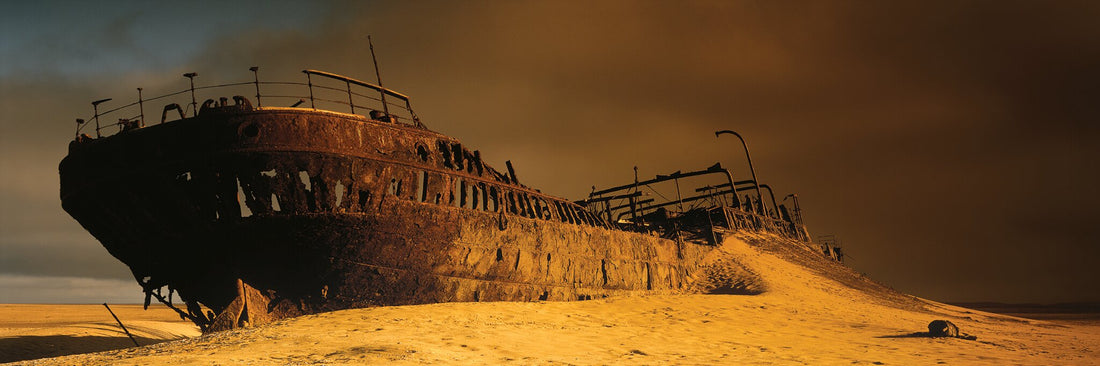
Evolution No.5, a Namibia shipwreck print by Koos van der Lende of the Bohlen wreck