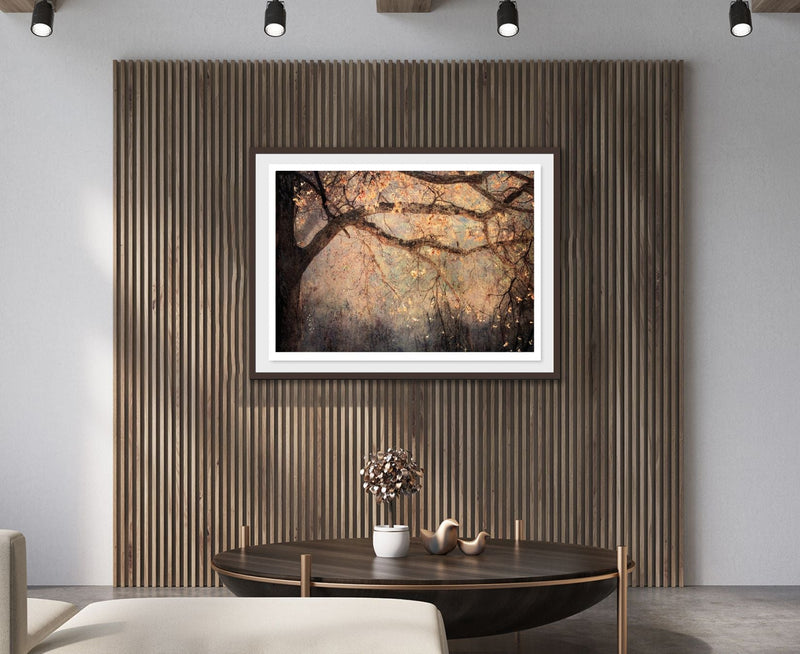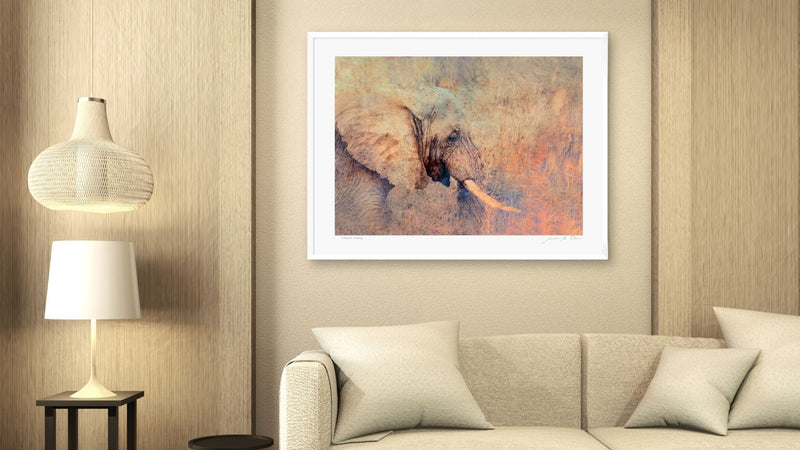



While discussing print selections with an interior designer some years ago, he said to me, “Never forget, Martin, great design lies down quietly and behaves itself.”
Then, in almost complete contradiction, he went on to say, “If it doesn’t clash, it doesn’t really match.”
I certainly agree with the wisdom of his first statement; however, I am still trying to get my head around the second.
So this begs the question: why is it that, when selecting wall art, most people tend to choose simplistic imagery over something more complex?
 Allow me to share my thoughts as I throw my ten cents’ worth into the debate.
My first point is that we, as humans, are continually bombarded with visual information as we navigate our way through everyday life. Modern technology has amplified this considerably. Phones, computers, television, cinema, advertising, social media and countless other visual distractions compete for our attention every waking hour.
To cope with this visual overload, we have become remarkably good at choosing what we wish to look at and, perhaps more importantly, ignoring what we don’t.
The human visual system is quite extraordinary and can perhaps best be described as a form of selective peripheral vision combined with an exceptionally fast autofocus system.
Let me explain.
Subconsciously, we can perceive and understand the entire scene in front of us, yet we can only concentrate our focus on one element at a time. The visual information surrounding the point on which we are concentrating gradually becomes less defined.
With our eyes working in close partnership with the brain, I believe this system helps us cope with the enormous amount of visual stimulation we experience every day. We remain aware of what exists within our peripheral vision, but our attention is directed towards one element at a time.
The fascinating part is that our eyes shift focus so quickly that we are led to believe we are seeing everything clearly and simultaneously. In reality, our attention is continually moving from one point to another.
 This phenomenon applies to almost everything we see, from observing a vast landscape to inspecting something close up.
I like to explain it to my students this way: when funds are tight, we somehow manage to look at a particular transaction on our bank statement without seeing the balance - even though the two columns are right next to one another. Selective vision can be remarkably convenient!
 My second point is that mankind can be rather lazy when confronted with mass visual stimulation - and art is no exception.
Unless we are genuinely interested in something, we would often rather ignore it than have to concentrate on too many competing elements. Again, I suspect this is partly a coping mechanism. We are exposed to so much visual information that our brains naturally look for ways to simplify what is in front of us.
Interestingly, the same principle applies when we move to the other side of the coin and begin creating photographs or artwork ourselves.
Many artists would agree that there is exceptional power in simplicity. This is particularly true in photography, where the camera lens has an inconvenient habit of recording everything placed in front of it.
For the photographer, deciding what to leave out of a composition can therefore be every bit as important as deciding what to include.
It sounds almost illogical. One might imagine that adding more elements would automatically create more interest, but art seldom works that way.
By removing unnecessary components from a composition, the artist creates space for mystery, curiosity and interpretation.
Successful art does not always need to tell the entire story. Often, it is far more powerful to introduce the subject, offer the viewer enough information to become engaged, and then allow them to complete the story through their own imagination.
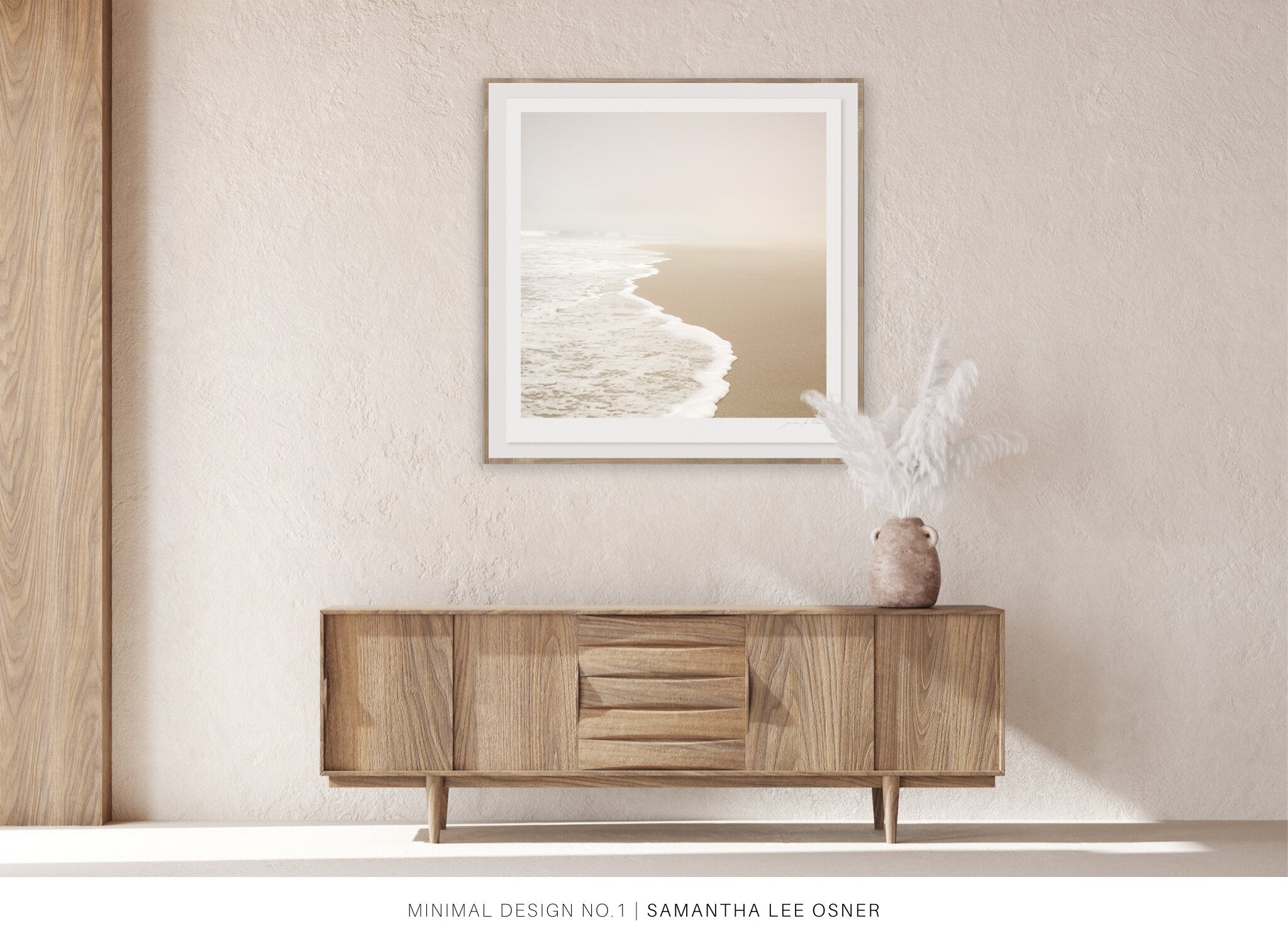 And that brings me to artwork displayed within an interior.
I have found that prints are often most effective when they are given the opportunity to become a focal point while still complementing the design around them. Once again, simplicity is often the key.
When too many artworks are displayed close together, or when the artwork itself contains an overwhelming amount of visual information, individual pieces can struggle to hold the viewer’s attention for many of the reasons discussed earlier.
A larger artwork given sufficient space to breathe can have an entirely different presence. Likewise, an artwork built around a simple, considered composition can create a feeling of openness and calm while simultaneously attracting more attention.
In these situations, less is undoubtedly more.

It has been said that if you leave room for misunderstanding, chances are you will be misunderstood. So let me make my point as clearly as possible.
What I am not saying is that simplicity is the only option when choosing wall art.
Far from it.
There are many genres, styles and approaches to consider, and every person responds differently to art.
Documentary imagery, for example, can encapsulate fascinating stories and transport us back to moments in time.
Landscape photography can evoke emotion and awaken memories of places once visited -or places we still long to experience.
Portraiture can remind us of people we know, celebrate character and reveal cultural influence.
Still-life imagery can elevate familiar objects and iconic design into something extraordinary.
And abstract art can challenge the imagination in ways that representational art sometimes cannot.
There is a place for all of it.
Having worked with many different clients, interior designers and architects over the years, I know that there is no single recipe that will suit everyone. There are countless ways to create impact within an interior and just as many ways to experience and enjoy art.
But, and it is a rather important but, simplicity has an extraordinary ability to stand the test of time.
 It can be applied across almost every genre, artistic style and medium. It does not necessarily mean empty, plain or uninteresting. Rather, it means considered. It means allowing the essential elements within an artwork enough space to communicate.
Perhaps that is why simple artworks so often continue to reward us long after the initial excitement of seeing them has passed.
Leonardo da Vinci is famously quoted as saying:
“Simplicity is the ultimate sophistication.”
And perhaps this philosophy extends far beyond art and interior design.
Sometimes the greatest skill lies not in knowing what else to add, but in recognising what can be taken away.
Besides art, simplicity in life itself may well be the true genius of all.
Best wishes,
VIEW ALL THE PRINTS IN OUR MINIMAL ART COLLECTION >>

Featured Print | Serenity No.3 by Samantha Lee Osner