


Every artwork has its own sense of time. Some arrive fully formed; others wait patiently, quietly holding their potential until the artist has grown enough to hear what they are asking for.
When I first began my creative journey, my work was rooted in straightforward photography. I was particularly drawn to landscapes and seascapes — to the quiet dignity of the natural world and the calm that settles over a scene when one truly looks. Those early years were formative in ways I could not fully appreciate at the time. I was learning not only to work a camera but to develop a visual language: a way of seeing that would eventually shape everything that followed.
Much of my thinking during that period was shaped by the guidance of my father, Martin Osner, a photographer whose influence on my eye and my instincts has been immeasurable. Amongst the many techniques he introduced me to was pinhole photography — one of the oldest and most meditative forms of image-making. There is something deeply humbling about working with a pinhole camera. The exposure times are long, control is relinquished, and the resulting image carries a softness, an otherworldliness, that no lens can manufacture. It taught me early on that the most compelling images are often those that resist clarity.

Collections such as Daydreams and Eternity reflect the sensibility I was cultivating during that formative period. In Daydreams, the pinhole process lends the work an almost dreamlike dissolution — figures and landscapes dissolving at the edges, caught somewhere between memory and imagination. Eternity, by contrast, draws on the long-exposure technique to transform moving water and shifting sky into something serene and almost sculptural. The turbulence of the sea becomes silk; time itself becomes visible. Both collections share a preoccupation with stillness, with atmosphere, and with the quiet emotional charge that simplicity can carry.
These are not merely technical exercises. They are meditations. And they prepared me — slowly, patiently — for the more layered, complex work that was to come.
The Turn Towards Mixed Media
As my practice continued to evolve, I began to feel that the photograph alone — however carefully composed — was not always sufficient to contain the feeling I was reaching for. Through further study with my father and an ever-deepening curiosity about artistic techniques, I began to explore how traditional art techniques might be introduced into my photographic work. Not as decoration, but as a genuinely integrated element — a way of extending the image's emotional range.
This shift was not immediate. It unfolded gradually across collections such as Whispers of Nature and Harmony of Gold, where photography and fine art technique began, tentatively at first and then with growing confidence, to speak the same language. I came to understand that a photograph is not necessarily a finished thing — it can be a foundation, a beginning, a surface to be worked.
Sometimes an artwork needs time before it reveals what it wants to become.
The image was simply waiting for me to develop the techniques and
confidence needed to truly bring it to life.
The Making of Symphony
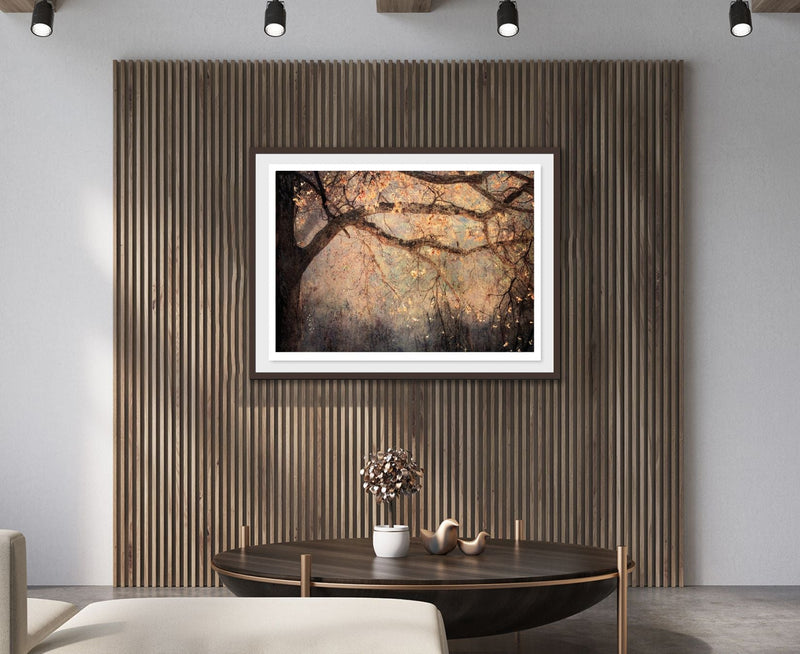
The starting point for Symphony had been sitting in my archive for what felt like a very long time — a photograph of a beautifully shaped tree, its autumn foliage glowing in warm backlight, the branches arching with an almost musical grace. I had always been drawn to the image. There was something in its structure and its light that I believed was worth pursuing. Yet for a long time, I could not quite identify what it needed.

Choosing the right subject is, in itself, one of the most demanding aspects of this kind of work. Each discipline in my practice — pinhole, long exposure, mixed media — carries its own distinct challenges. But in this more layered approach, the initial decision of where to begin, which image holds sufficient depth to bear the weight of additional intervention, is every bit as demanding as the technical work that follows. It requires a particular kind of patience and discernment: the willingness to sit with an image and wait for it to speak.
When I eventually began experimenting with Symphony, I started by overlaying painted textures during post-production — layers I had created myself, built up with an eye to atmosphere rather than precision. Almost immediately, the photograph began to change. The painted elements settled into the background in a way that felt entirely organic. Busy areas of the image were calmed; the overall mood became richer, more atmospheric, more interior. The tree, already compelling, began to breathe.
And yet, even after the digital layers were resolved, I felt the work was not complete. There remained a quality of flatness — of distance — that I wanted to dissolve. I printed the piece on fine art paper and began working directly onto the surface with acrylic paints, attending carefully to the leaves, reinforcing their warmth and their light. Finally, I applied delicate touches of gold leaf to the sunlit foliage. That was the moment Symphony truly arrived.

The Living Quality of Texture
It is difficult to convey in any reproduction what gold leaf does to an artwork when encountered in person. Photography — however skilled — cannot fully capture it, and this is by design. The gold does not sit on the surface so much as inhabit it: it catches and releases light differently depending on the angle of one's gaze, the quality of the light in the room, the very movement of the viewer past the work. In certain lights, the leaf seems almost to pulse. The artwork becomes genuinely alive in a way that is simply not achievable through any digital means.
There is something particularly compelling about the relationship between texture and organic subject matter. Trees, with their intricate networks of branch and bark and leaf, are inherently textural subjects. Their surfaces are layered, complex, and endlessly varied. When an artwork built upon such a subject is then further enriched with physical texture — the raised quality of built-up acrylic, the shimmering relief of gold leaf — the result is not merely visual. It is haptic. One feels an almost physical pull towards the surface, a desire to draw close and look again and again, because the work genuinely rewards that attention with something new each time.
This is the dimension of Symphony that one must experience directly to fully understand. In reproduction, it is a beautiful image. In person, it is a different category of thing altogether.
A Note on the Edition
Symphony is produced as a limited edition of ten. Each print is individually embellished by hand — the acrylic and gold leaf applied afresh to every work in the series. To the casual eye, the ten works appear identical. But place any two side by side and the differences become apparent: a slightly different distribution of gold, a subtly varied weight of paint in one passage, a small divergence in the way light falls across a particular branch. Each is its own object. Each is, in the truest sense, an original.
Art as Accumulation
For me, Symphony represents something more than a single resolved artwork. It is an account of how a creative practice accumulates — how the skills and sensibilities developed across years of work in one medium eventually find their expression in another; how patience and curiosity and a willingness to experiment can transform an image that was almost right into one that is, at last, complete.
Art, in my experience, is never a linear progression. It is a conversation — with one's materials, with one's history, with the work itself. The photograph of that tree had been waiting. And when the moment came to answer it, I found that every stage of my journey — the pinhole studies, the long exposures, the painted textures, the gold — had been, in its own way, a preparation for this.
Symphony · Archival print on fine art paper with acrylic & gold leaf · 141 × 110 cm · Edition of 10